
Central Heating
Central Heating That Earns Its Place in the Building.
The heat source and everything downstream of it. Bongioanni gas condensing and cast-iron boilers from Italy, sized against the building's actual heat loss, plus the pipe, manifolds and controls that carry that heat to the rooms.
Replacing an existing boiler
Replacing a Boiler Is a Technical Decision, Not a Rushed Purchase
A boiler is more often replaced than chosen. It gets bought in the week the old one stopped working, under pressure, from whatever happens to be available. That is how a building ends up with a unit that is the wrong output, the wrong flue type, or the wrong match for the pipes and radiators it was connected to.
We treat a replacement the way we treat a new specification, with one difference: the constraints are already there. The existing flue, the existing pipework and the space the old unit occupied settle most of the answer. Four questions settle the rest.
Will it work with my existing radiators and pipework?
What about my existing flue or chimney?
How quickly can this happen?
Can you look at what I already have?
The review costs nothing and commits you to nothing. If the recommendation is that the existing unit does not need replacing yet, that is the recommendation you will get. If you are specifying rather than replacing, the rest of this page is the range itself: what it is built from, who it suits, and what comes with it.
Why Bongioanni
Bongioanni is an Italian manufacturer with decades of heritage in heating technology for both domestic and industrial applications. What distinguishes Bongioanni in the Jordanian market is not marketing. It is metallurgy: heat exchangers built to withstand the real operating conditions of Middle Eastern installations, burners serviceable by technicians on the ground, and control systems straightforward for maintenance crews to live with over the life of the asset.
We stock the Bongioanni range directly from the factory, with no middlemen, so every unit is authentic, fully warranted, and backed by a single point of technical support.
Key Benefits
- 5-year manufacturer warranty: Bongioanni's own cover, honoured direct because there is no middleman between you and the factory
- Fuel flexibility: gas and diesel options to suit the project and the available connection
- High-efficiency condensing: the Play range condenses for strong seasonal efficiency and lower running costs
- Built for service life, not just certification: serviceable burners, replaceable components, common spare parts
- Compatible with underfloor heating and radiators: pairs directly with our Maincor range
- Supplied direct, warranted original: no grey-market units, no warranty risk
Who This Is For
- Homeowners and building owners replacing a boiler that has failed or is near the end of its service life
- Facilities managers replacing aged or unreliable plant in buildings that are already occupied
- Mechanical engineers and consultants specifying central heating for villas, apartments and small commercial projects, including low-temperature and hybrid schemes
- Developers and contractors needing reliable heating for residential portfolios
A boiler is a long-term decision. It is specified once and lived with for years, so what matters is not the headline output figure but whether the unit still suits the building a decade in, and whether it can still be serviced when it needs to be.
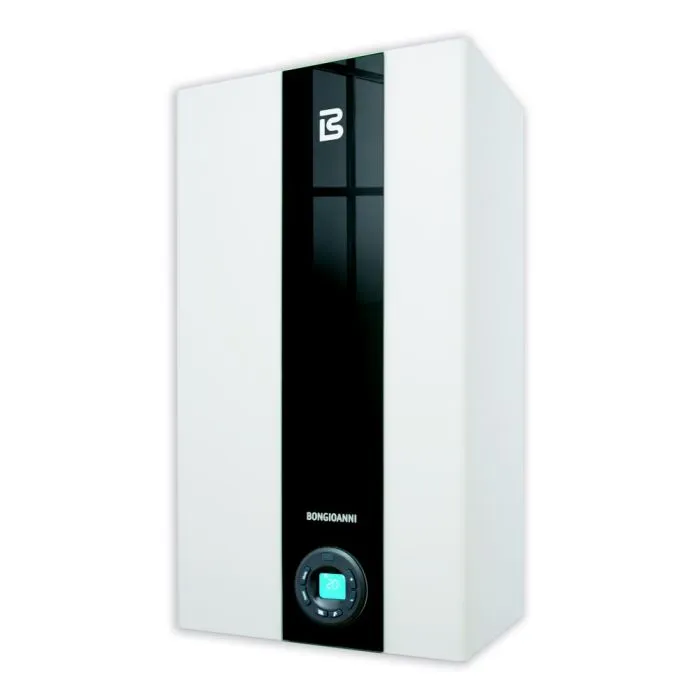
Our Bongioanni range is built around that reality. It runs from the compact Play wall-hung condensing units at 20 to 34 kW, through floor-standing Multidea Evo 2 condensing plant at 45 to 95 kW, to cast-iron oil-fired sectional boilers from 38 to 93 kW for buildings with no gas connection. Wider Bongioanni outputs, and traditional atmospheric units for buildings served by an existing open flue, are available to order rather than held in stock. Where a project also calls for a heat pump or a hybrid setup, we source that separately, outside the Bongioanni range.
Critically, everything we supply can be serviced. Burners can be stripped and cleaned. Components can be replaced. Spare parts are sourced through the same direct channel as the original units. This matters ten years into the life of the building, when the specifier is long off the project and the owner still needs the system to work.
A central heating system is more than its boiler, and we supply the rest of it too. The pipe, manifolds, zone actuators and controls that carry heat from the plant room to the rooms come from the same counter, whether the distribution is radiators or underfloor loops. That matters because most of what goes wrong with central heating in Jordan is not the boiler. It is a system that was never balanced, or a zone that was never controlled separately, with an oversized boiler short-cycling to compensate for both.
Every supply comes with sizing and fuel-selection support, so the unit is matched to the building rather than to the space the old one happened to occupy.
The Boiler Sits in the Middle of the System
A boiler is sized by what it has to heat, and it works less hard when something else heats the water first. Both of those are decided before the boiler room is drawn.
Maincor Underfloor Heating
Underfloor heating is what the boiler feeds. The loops run at 35–45°C against 60–75°C for radiators, and water coming back that cool is what allows a condensing boiler to reach the efficiency it is rated for.
View the systemLato Solar Water Heating
Solar and the boiler are not alternatives: the collectors preheat the stored water and the boiler makes up only the shortfall, at night and on overcast days.
View the systemHVAC Consultancy & Sourcing
The heat loss that sizes the boiler and the cooling load that sizes the air conditioning come off one building model, and a heat pump or hybrid arrangement is sourced outside the Bongioanni range.
View the systemWhere the fixings are specified with the unit, we can supply the Fischer range, with the anchor selected against the actual wall material rather than an assumed one.
Technical & Compliance Hub
Official technical compliance certificates and system declarations from the manufacturer.
| Feature | Specification |
|---|---|
| Warranty | 5-year manufacturer warranty |
| Boiler Types Available | Wall-hung gas condensing (Play), floor-standing gas condensing (Multidea Evo 2), cast-iron oil-fired (Hola Plus / T04) |
| Output Ranges | 20–34 kW wall-hung gas condensing; 45–95 kW floor-standing gas condensing; 38–93 kW cast-iron oil-fired. Wider Bongioanni outputs available to order. |
| Efficiency Rating | Up to 108% for condensing range (Play series) |
| Fuel Options | Natural Gas, LPG, Diesel / Gasoil |
| Combustion Control | BEST self-check system (Bongioanni Emission Self Test) |
| Flue Type compatibility | Type C (room-sealed, fan-assisted), Type B (open-flue, atmospheric) |
| Body Materials | High-grade Aluminium-Silicon heat exchangers / Cast-Iron GJL-200 |
Output matters more than the name on the casing. An oversized boiler short-cycles, burns gas it does not need to and wears out early; an undersized one never reaches temperature on the coldest days of the year. If the boiler you already have has stopped rather than been outgrown, the flue components, LPG conversion kits and controls that fit it are held over the counter.
Frequently Asked Questions
How much does gas central heating cost to run in Jordan?
Running cost is driven by three things: the fuel, the boiler's efficiency, and how well the system is zoned. Gas typically runs meaningfully cheaper than diesel for the same heat, and a condensing boiler recovers heat from its own flue gases that a traditional unit throws away. That recovery only happens if the system returns water cool enough for it to condense, which is a design question rather than a purchase question. A zoned system that heats occupied rooms instead of the whole house is usually the single largest saving available, and it costs far less than replacing a boiler.
My boiler has failed. Can you supply a replacement that fits?
Usually, yes. What you should not assume is that the old output is the right one: a boiler that was oversized on the day it went in will be oversized again if you replace it like for like, and that is the most common way a replacement goes wrong. Most Jordanian replacements land between 20 and 34 kW wall-hung gas. For the compatibility questions, your existing radiators, your existing flue and how long the work takes, see the replacement section above.
Do you service and repair boilers?
We do not carry out the work ourselves. What we do is diagnose what has actually failed, supply the part, and put you in touch with a technician who can fit it, then stay available to both of you while the job is done. We hold flue components, LPG conversion kits and boiler spares, and everything we supply is designed to be serviced rather than replaced: burners strip and clean, components swap out.
What size boiler does a Jordanian villa need?
It depends on the building's heat loss rather than its floor area. Insulation, glazing, exposure and how many rooms are actually heated all move the answer, so a 300 m² villa can legitimately need anywhere between 24 and 45 kW. Oversizing is the common error: a boiler too large for its load short-cycles, burns gas it does not need to and wears out early. Send us the drawings and we will size it properly at no charge. There is a fuller explanation in the guide linked below.
Gas condensing or cast iron?
Gas condensing where mains gas or LPG is available and the system can be designed to run at low return temperatures, because that is where the efficiency actually materialises. Cast iron oil-fired where gas is not practical, or where the building already runs on diesel and the distribution is designed around higher flow temperatures. We supply both, from 20 to 95 kW condensing and 38 to 93 kW cast iron, and the honest recommendation follows the fuel available at the site.